Showing posts with label orchid. Show all posts

Saturday, November 9, 2024

Microcoelia obovata


Distribution

Kenya, Tanzania, Mozambique and in South Africa along the northeast KwaZulu-Natal coast.

Description

Microcoelia obovata miniature sized, hot to warm growing leafless epiphyte with thick stiff tangled roots.

Microceolia is a genus consisting of 31 species endemic to Africa 3 species occurring in South Africa, M. aphylla, M. exilis, M. obovata. All species are monopodial and leafless with an extensive branching root system with long roots resembling an untidy bird’s nest. The roots grow into open clumps that allow a maximum amount of light to reach all of the roots. The roots contain the chlorophyll that aids in photosynthesis. Plants have a stem from which very small, green or white tinged flowers are borne on a flowering stem.


Habitat

Very localized in hot humid woodland, grasslands and riverine forests often in exposed locations from sea level to 250 m.  

Flowering Period

Microcoelia obovata flowers for me north of Durban at the end of October into November


Cultivation

As with the other two species of South African Microceolia it is very easy to grow in cultivation provided it is hot and humid enough and given adequate light.

Watering

My plants get misted daily other than when we experience cold wet days.

Feeding

I feed my plants once to twice per week with a very diluted fertilizer making sure to drench the plants heavily between feeding to prevent salt buildup which is fatal to all Microceolia species.

Article written by Michael Hickman on the 

09.11.24

Please visit my websites at

www.ecoman.co.za

www.hlem.co.za

https://www.hlem.co.za/indigenous_plants/plants.html

other blogs at 

https://ecomandurban.blogspot.com/

https://luthulienvironment.blogspot.com/

https://emalangeniforest.blogspot.com/


Saturday, April 27, 2024

Vanilla roscheri


Vanilla roscheri

Family:  Orchidaceae


The flower of Vanilla roscheri photo taken by Roddy JC Ward

A very attractive orchid that has a widespread range in eastern tropical Africa, from Kenya, Tanzania and Mozambique with one officially recorded record from South Africa. The specimens found in South Africa were found on the shores of Lake Sibaya by Mark Ward in 1983 where herbarium specimens were collected by him on the 05/02/1983 and again on 01/07/1983 which were submitted to the Herbarium at the Royal Botanic Gardens by his father Roddy Ward. I am very fortunate to have been given a live piece of the original plant collected.

Status in South Africa   

Near Threatened* D2 assessed on the 02.09.2005 by L. von Staden and J.E. Victor

Known from one location in South Africa. Potentially threatened by subsistence agriculture, expanding informal settlements and alien plant invasion. The national assessment is downgraded from VU to NT as other subpopulations just across the border in Mozambique could serve as sources of propagules to South African locations.

Note:

This species may be conspecific with Vanilla phalaenopsis Reichenbach f. from the Seychelles and with Vanilla madagascariensis Rolfe from Madagascar, if so, Vanilla phalaenopsis would be the correct name.

Description

Vanilla roscheri is a leafless, terete liana-like climber with green succulent stems up to c. 1.5 cm in diameter with short thin wiry attachment roots at the nodes and at intervals along the length of the stem different feeding roots are send down to the ground where they take up water and nutrient in the leaf litter and soil to sustain the plant. These orchids are not epiphytes but terrestrial orchids that grow in the ground and along the forest floor then climb up into the canopy to get more light to flower and must therefore be planted into sufficiently large pots or in the ground if grown outdoors to do well.


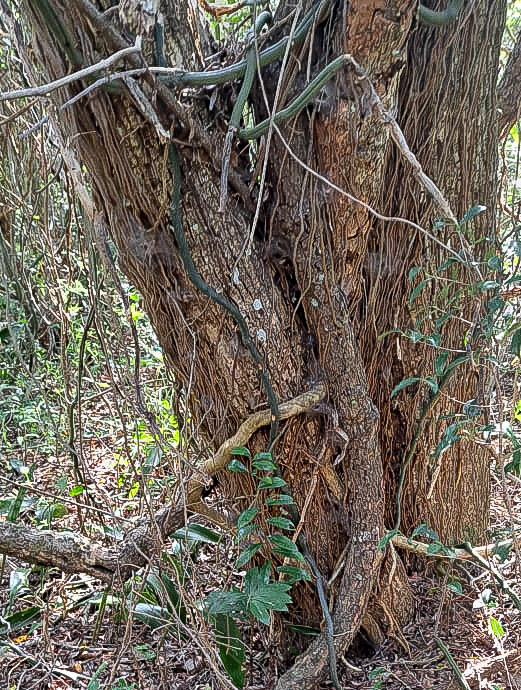
Here one can see the huge amounts of roots sent down by a plant growing in the forest canopy to sustain growth.

Small brownish vestigial leaves up to 3 cm long are present at the nodes on new growth which fall off after a few months.

Here the vestigial leaves are clearly seen on Vanilla roscheri grown in my lounge

A very distinguishing feature of this species are two shallow channels on each side running the length of the vine between the internodes which are up to 15 cm long.

Here one can see one of the two shallow channels on each side the vine of Vanilla roscheri as well as one of the feeder roots and the thin roots used as to attach themselves when climbing into the canopy.

The inflorescence is many-flowered, up to 30 cm long, terminal or at the nodes. Flowers are large and showy, up to 15 cm in diameter, white, more or less flushed with pink, strongly and sweetly scented. Lip funnel-shaped, often salmon-pink or yellowish in the throat. Capsule up to 17.5 cm long


Photo of flower of Vanilla roscheri taken by Roddy JC Ward

Habitat

Vanilla roscheri are found growing where it is hot and humid near to the coast in mangrove forest, evergreen scrub, coastal bush and forest, and in grassy fields rocks and scattered trees at elevations in South Africa 1-100 m, elsewhere at elevations of 0 up to 1050 meters

Cultivation

Vanilla roscheri which is easy to grow likes to grow at warm to hot temperatures with high humidity with the lower part of the plant and the roots in shade, the top of the plant in partial shade to full sun for them to flower.

Seed pods of Vanilla roscheri growing on Erythrina latissima in full sun at Lake Sibaya Photo taken by Roddy JC Ward

Vanilla roscheri plants require a large pot filled with a very loose well drained open growing medium with lots of space for climbing. I used to grow mine in very coarse sieved well drained leaf mould containing many sticks and partially decomposed leaves to which can be added some crushed egg or snail shells. I have however found that they grow just as well or better in a very open growing medium of fine medium and course silica sand with a little peat or coconut peat added. It is essential to add good drainage and airholes on the sides at the base of the pot or to place the pot on feet. The plants must be allowed to dry out somewhat before watering. Reduce the watering in the cooler months. They need good air movement and respond well to misting. They respond well to a regular addition of a very weak solution of liquid fertilizers and or a littler slow release fertilizer such as Multicote™ controlled release fertilizer  . Flush out the pot well with clean water from time to time to avoid salt build up.


Vanilla roscheri growing indoors

I feed my orchid plants with soluble inorganic fertilizer used in hydroponics for flower and fruit growth to which I add both humic and fulvic acid, Seagro which is an Organic Plant Food, a nutritious fish emulsion, Marinure® which is a unique biostimulant brown seaweed, Ascophyllum nodosum and Nitrosol, which gives excellent results. I occasionally water my plants with plant growth stimulants derived from sea weed.

The Royal Botanic Gardens at Kew

Herbarium Catalogue


Family: 

Orchidaceae


Current Name:  

Vanilla roscheri Rchb. f.


Collector:           

Ward, C.J.; Ward, M.C.     

Plant Parts:        

Flowers/inflorescence; Fruit

Collector no:     

59


Collection Date:

05/02/1983


Country:             

South Africa

Habitat:              

Light shade; sand termite mound. Dry woodland-forest, mainly just within margin. Frequency; Locally common.

Location:

KwaZulu-Natal Ingwavuma Sibaya lake south west

Plant Description:

Shallowly rooted in litter on sand or pseudo-epiphytic.

Lat and Long:

27 21 S , 32 36 E


General Comments:

Sheet 1. Duplicate Ex Herbarium: University of Durban-Westville, Natal, South Africa.


http://www.africanorchids.dk/357-vanilla/386-vanilla-roscheri

http://apps.kew.org/herbcat/detailsQuery.do?barcode=K000392070

https://orchids.fandom.com/wiki/Vanilla_roscheri

https://www.mozambiqueflora.com/speciesdata/species.php?species_id=180910

http://redlist.sanbi.org/species.php?species=2771-1

Article written by Michael Hickman on the 09.03.21 edited and reposted on this blog

27.04.24

Please visit my websites at

www.ecoman.co.za

www.hlem.co.za

https://www.hlem.co.za/indigenous_plants/plants.html

other blogs at 

https://ecomandurban.blogspot.com/

https://luthulienvironment.blogspot.com/


Tuesday, November 28, 2023

Polystachya pubescens The Fine-Haired Polystachya


Polystachya pubescens

The Fine-Haired Polystachya

amabelejongosi (Zulu)

Distribution

Polystachya pubescens is a small compact orchid species which is common in South Africa, from the Eastern Cape in the south to Zululand, it is also found in eSwatini (Swaziland) and Eastern Zimbabwe where it is rare. This is a summer rainfall region where the plants may in some areas experience a prolonged dry season during the cooler winter months.

Habitat

Polystachya pubescens is found growing in coastal forests as well as a lithophyte out in the full sun or partial shade on sandstone outcrops. In the Pondoland region it can be found growing in large mats on sandstone rocks in the full sun, these plants are generally very small and have leaves that are a pronounced purple colour because of the intense light. In the lower light conditions of forest the plants grow much larger and are a dark green. This delightful fragrant epiphytic orchid produces bright yellow flowers in early summer. Polystachya pubescens grows in a region that has neither very high or low temperatures and is recorded as having a low tolerance for extreme cold.

Uses

Because of its showy flowers and relative ease of culture, Polystachya pubescens is a popular orchid plant amongst specialist orchid growers .

Polystachya pubescens is used extensively by the amaZulu people as a protective charm and as a love potion.

Growing Polystachya pubescens

Polystachya pubescens plant grows easily in the milder regions of the country if it is attached to a branch of a tree.

Polystachya pubescens is very easy to grow and is ideal for beginners to start with. It grows well in a small plastic or ceramic pot filled with fairly large pebbles, placing larger pebbles at the bottom of the pot and smaller ones at the top. Over a period of at least 50 years I have successfully grown them on river pebbles or crushed stone in particular sandstone as well as decaying granite. Bark may be used but it breaks down far to quickly and causes the roots at the bottom of the pot to rot.

As with all orchids never be tempted to over pot them, the rule of thumb is to put orchids and most other plants into as small a pot as possible. They can also be mounted of a slab of wood, bark, fern fiber etc. however they grow best in pots.

Light requirement

In cultivation if grown outdoors they do best in light to medium shade, under lights indoors I have found that they do well at 3500 to 5500 lux with a photo period of 16 hours in summer and 12 hours in Winter.

Ventilation

They require good ventilation, when grown indoors I have the windows open and fans running 24  hours a day during the growing season when it is hot and humid and for a few hours a day during the middle of the day in winter.

Watering and Feeding

Like most living organisms orchids tend to like to be fed daily during the growing season to remain healthy and to grow well. For those plants that need a rest period in the winter months l reduce both the amount of feed and the frequency of watering watching carefully that the plants do not desiccate.

I am a firm believer in giving a very varied diet to my plants, which I feed at very low concentrations with every watering, which is usually daily on my epiphytes and lithophytes. Once a week I give my plants a drenching with pure water to remove any buildup of harmful salts on the plants and in the potting medium.

Here is a list of what my plants get as feed and growth promoters, every day a different feed, on occasion I mix a feed and a growth promoter.

1.      Water soluble mineral fertilizer used for growing plants in hydroponics, here I used formulations for flowers and fruits.

2.      Nitrosol

3.      Seagro

4.      Fulvic acid

5.      Rooibos tea

6.      Black tea

7.      Green tea

8.      Cinnamon tea

9.      Banana skin tea

10.   Leaf mould tea

This is certainly not the only way to grow Polystachya pubescens but has worked well for me over many years to grow hundreds of strong healthy plants.

General information

The name Fine-Haired Polystachya refers to the fine hair on the lip of the flower.

About one third of orchid species possesses deceptive pollination mechanisms where no rewards are provided to the pollinators

However, many species of Polystachya appear to give rewards in the form of pseudo-pollen in the form of food hair on the lip.  Inside of pseudo-pollen food hair, Polystachya species provide protein, starch, and or lipids. Different species provide different combinations of these nutritional rewards.  The hair on the lip of Polystachya pubescens could be a reward, the main nutrients in the hairs are proteins. Although it is known that the hairs are rich in proteins, we do not know if the pollinators are in fact attracted to them because the pollination system of this species is not well studied.


 written by Michael Hickman on 28.11.23

www.hlem.co.za

www.ecoman.co.za

Eulophia friderici

  Eulophia friderici belongs to the plant family Orchidaceae subfamily Epidendroideae, tribe Cymbidieae, subtribe Eulophiinae. I have also f...